Using
Year
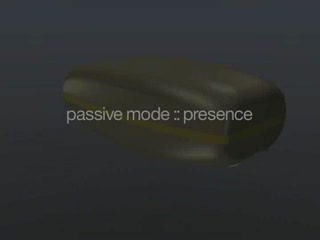
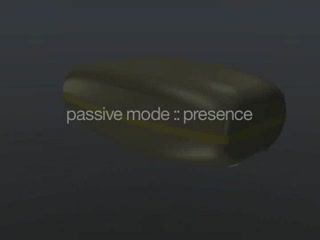
amia is the first device within a framework that we call “amiable media”, or technologies that aim at integrating the physical and digital worlds to give rise to new forms of interpersonal communication. We did a simple user survey beforehand to get an idea of how people communicate with loved ones, what that form of communication misses from face-to-face communication, and whether or not people would be interested in a device like amia. amia is a device for helping two people keep in touch: think academic couples separated by long distances, a spouse who travels frequently, and so on. The device has two main modes: passive and active. In passive mode, microphones on one device pick up the ambient noise level and transmit this noise level to the companion device. A band the encircles amia glows in response to the ambient noise level of the other device. In this way, we have a means of indicating the presence of the other person without being too intrusive. The second mode is the active mode, made up of a number of components. First, heat sensors on device will activate when a person handles the device; this information is transferred to the companion device and translated into a more “reddish” color as the temperature on the other device increases. Secondly, capacitive sensors pick up hand motions across the outside of the device, which are converted into pulses or sequences of light; the user can then “compose” sequences of light patterns to send to the companion device, thus allowing for abstract interpersonal communication. Finally, actuators on the surface of the devices can be pushed in or popped out; pushing in on one device leads to popping out of the corresponding actuator on the companion device. Thus the users can, perhaps, send messages or play games using these push-in, pop-out components. The goal with this project was to try and find a way for two people separated by distance to keep in contact non-verbally, since cell phones and IM are so prevalent, but yet miss out on a lot of the nuances of real-life interpersonal communication.

Images
Add new comment